If you’re a parent considering artificial grass for your backyard, school, or childcare centre, safety is likely the first question on your mind. Is it non-toxic? Does it get too hot in the Queensland sun? What happens when it rains?
These are fair questions, and the good news is that modern, quality artificial grass is designed with children specifically in mind. Here’s what Brisbane parents, childcare providers, and school facilities managers need to know.
Does artificial grass meet Australian safety standards?
In Australia, play surfaces used in childcare centres, schools, and public playgrounds are required to meet strict guidelines around impact absorption, also known as soft fall. The relevant standard is AS 4422, which sets minimum requirements for how well a surface cushions a fall.
Quality artificial turf, when installed correctly over an appropriate base, can meet or exceed these requirements. At Turf Green, we work with childcare centres and schools across Brisbane and SE Queensland to install surfaces that comply with safe play area requirements. The key is the combination of turf pile height, underlay, and base preparation, not just the grass itself.
If you’re installing turf in a play area, always ask your installer about soft fall compliance and what base system they use beneath the turf.
Is artificial grass toxic?
This is one of the most common concerns we hear from parents, and understandably so. The short answer is that quality artificial grass products from reputable manufacturers are non-toxic and safe for children.
The concern often stems from older surfaces that used crumb rubber infill made from recycled tyres, which contained compounds some researchers flagged as potentially harmful. Today, many residential and childcare installations use alternative infills such as silica sand or organic options, or no infill at all depending on the product.
At Turf Green, we use products from trusted manufacturers and can advise you on the most appropriate infill for your situation. If you have specific concerns, ask for product data sheets and look for turf that carries relevant certifications from the manufacturer.
What about heat in Brisbane’s summers?
This is a genuine consideration for Queensland families. Artificial grass does absorb heat from direct sunlight and can feel warm underfoot during the hottest parts of a summer day, just as paving, timber decking, and concrete do.
That said, there are practical ways to manage this. A quick spray with a garden hose cools the surface down rapidly. Shade from trees, sail shades, or a pergola makes a significant difference. We also supply UV-stabilised products designed to manage heat absorption, and certain infills can help reduce surface temperature.
In our experience, parents typically find that the surface is perfectly comfortable for children to play on in the morning and early evening, and that a bit of planning around shade goes a long way in the middle of summer.
Does artificial grass drain properly?
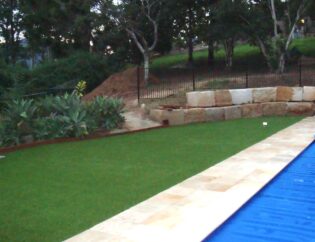
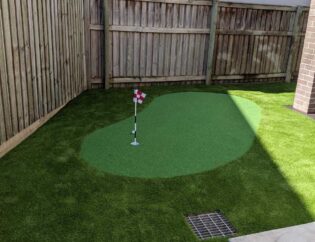
Good drainage is important for any play surface, both for usability after rain and for hygiene. Properly installed artificial turf includes a porous base layer that allows water to drain through efficiently. In most cases, it drains faster than natural grass.
At Turf Green, we tailor our base preparation to Brisbane’s soil conditions and account for the heavy rainfall events that come with Queensland summers. A well-installed surface should not pool water or become waterlogged.
From a hygiene standpoint, rainwater also naturally flushes and cleans the surface. For homes with pets or high foot traffic, a periodic hose-down keeps things fresh.
Is it suitable for childcare centres and schools?
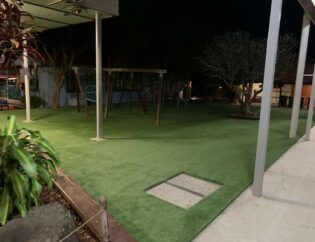
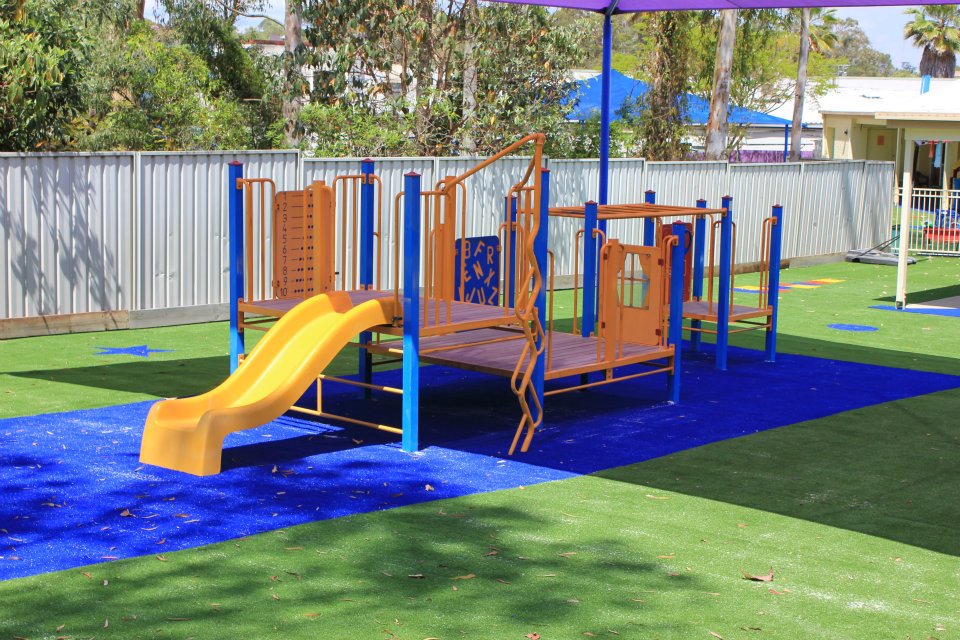
Absolutely. Turf Green has installed artificial grass at childcare centres and schools across Brisbane, the Redlands, Logan, the Gold Coast, and the Sunshine Coast. It holds up to heavy daily use, requires minimal maintenance, and creates a consistently clean, mud-free surface that educators and parents appreciate.
Unlike natural grass, which can become patchy, muddy, or uneven with constant foot traffic, artificial turf maintains a safe and even surface year-round. It also eliminates the need for pesticides or fertilisers, which is a meaningful benefit in environments where children spend time close to the ground.
To see examples of our work in early learning and school settings, visit our artificial grass for child care centres and synthetic grass for playgrounds pages.
What to look for when choosing artificial grass for children
When selecting a product for a space where children play regularly, keep these points in mind. Choose a manufacturer with a clear product specification and safety data. Ask your installer about soft fall compliance and base preparation. Opt for UV-stabilised products suited to Queensland’s climate. Consider shade options if the space will be used during peak heat hours. Discuss infill options and choose what makes sense for your specific situation.
If you’re unsure where to start, the team at Turf Green is happy to walk you through the options.
Ready to create a safer play space?
Whether you’re a homeowner wanting a cleaner, safer backyard for your children or a facility manager looking to upgrade an outdoor play area, Turf Green can help you find the right solution. We’ve been installing quality artificial turf across SE Queensland for over a decade and we understand what parents and childcare providers need from a play surface.
Get in touch with Turf Green for a free consultation and quote.